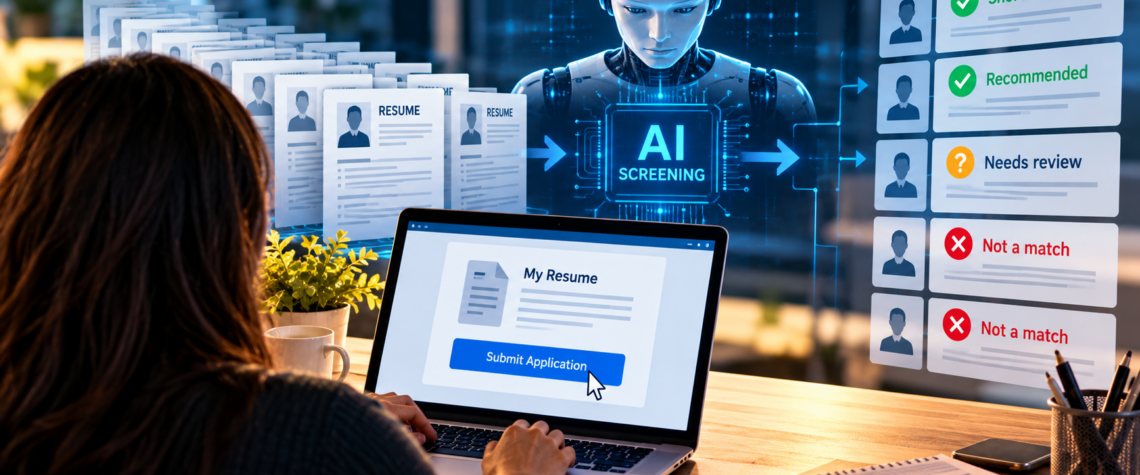
Employers are using increasingly sophisticated software to screen job applications. But how much power do these systems really have, and what can job seekers do to make sure their qualifications are not overlooked?
You find a job that seems almost perfect. Your experience matches the requirements, your education is relevant, and you have spent an hour carefully preparing your résumé. You submit the application online and wait.
Days pass. Perhaps weeks. Eventually, an automated rejection arrives—or nothing happens at all.
Did a hiring manager decide you were not qualified? Did another candidate have more experience? Or did a computer system determine that your application was not worth considering?
For a growing number of job seekers, the uncertainty has become part of the experience of looking for work.
Artificial intelligence and automated screening tools are changing how employers process applications, evaluate candidates, and organize recruitment. These technologies promise to make hiring faster and more efficient, particularly for companies receiving hundreds or thousands of résumés.
But they also raise troubling questions about fairness, transparency, and the possibility that qualified applicants may be overlooked before they have an opportunity to demonstrate their abilities.
The reality is more complicated than the popular image of a robot silently rejecting everyone who fails to include the right keywords.
Not every hiring system uses artificial intelligence. Not every automated tool makes hiring decisions. And an applicant who receives a rejection cannot assume that AI was responsible.
Understanding those distinctions is becoming an important skill for anyone looking for work.
The Invisible Gatekeeper
For years, employers have relied on software known as Applicant Tracking Systems, or ATS, to manage recruitment. These systems collect applications, store résumés, organize candidate information, track communications, and help recruiters manage the hiring process.
Many also allow employers to search applications, filter candidates according to specified qualifications, and identify people who appear to meet a position’s requirements. Artificial intelligence adds another layer of capability.
Depending on the product and its configuration, AI-enabled recruitment software may extract information from résumés, identify relevant skills, compare applicants with job descriptions, recommend candidates, or generate summaries for recruiters.
Some systems use statistical models to estimate how closely an applicant’s background matches the characteristics an employer is seeking. Others support online assessments or automated interviews.
The distinction matters because a traditional ATS is not necessarily an AI decision-maker. A database that stores résumés is fundamentally different from a system that predicts which candidates are most likely to succeed. And even when AI is involved, the employer may retain full responsibility for deciding whom to interview.
The question is not simply whether a company uses AI, but how much influence the technology has over the decisions that follow.
What Happens After You Click Submit?
Imagine an employer advertising a position for a project coordinator. The company receives 600 applications.
Rather than opening every résumé individually, its recruitment software may first extract information about each candidate’s employment history, education, and skills.
The employer might configure the system to identify applicants with experience in project management, budgeting, scheduling, or particular software applications.
Some systems can also use screening questions to determine whether applicants satisfy essential requirements, such as holding a required professional license or having authorization to work in the country.
Candidates who fail certain mandatory criteria may be removed from consideration automatically, depending on the employer’s rules.
Other systems may rank or recommend candidates without rejecting anyone.
A recruiter could then examine a smaller group of applications or review the entire applicant pool using the software’s organizational tools.
In this process, an applicant’s qualifications may be interpreted through several layers of technology before a hiring manager makes a decision.
But there is no single universal process. Employers use different software, apply different screening rules, and give automated recommendations different levels of authority.
That is why claims that every résumé receives an invisible AI score—or that every application is rejected by a robot unless it contains special keywords—are misleading.
A New Anxiety for Job Seekers
Recent research suggests that applicants are increasingly concerned about how automated hiring systems interpret their qualifications.
In October 2026, recruitment technology company Greenhouse published its Future of Hiring Candidate Report, based on a survey of more than 2,800 job seekers across five countries. According to the company, 77% of U.S. respondents had used AI during their job search in the previous year. The survey also found that 60% of respondents had changed or considered changing the way they wrote applications to avoid having their materials mistaken for AI-generated content. Meanwhile, 62% reported trying tactics intended to get past automated screening.
Some respondents acknowledged adding qualifications or keywords they did not actually possess, while others experimented with hidden text designed to influence automated reviewers.
These findings do not establish how frequently employers reject candidates through AI. They do, however, reveal a significant change in job-seeking behavior.
Applicants are no longer writing exclusively for hiring managers.
Many believe they must also satisfy an invisible technological audience.
The result is a peculiar contradiction: candidates use artificial intelligence to improve their applications while worrying that employers may penalize them for using it.
Can AI Overlook Qualified Candidates?
Yes, although the reasons may differ from what applicants imagine. An automated screening system can fail when it relies on incomplete information, poorly chosen criteria, inaccurate data, or assumptions that do not reflect the actual requirements of a job.
Consider someone who has managed a small business for 15 years. That person may have substantial experience supervising employees, preparing budgets, negotiating contracts, and coordinating projects. Yet a résumé describing those responsibilities in unfamiliar terminology might not communicate them effectively to a system configured around particular job-related skills.
Modern software may recognize equivalent terms, but that capability varies.
Another applicant may have developed valuable skills through military service, volunteer work, independent projects, or professional experience outside a conventional career path.
If a hiring system places excessive emphasis on particular job titles, educational credentials, or employment histories, it may undervalue those qualifications.
The problem is not necessarily that the technology cannot read the résumé. It may be that the criteria used to evaluate the résumé are too narrow. An automated system can process information consistently and still reach an unfair or unhelpful conclusion if the rules guiding its decisions are flawed.
When Algorithms Learn From the Past
One of the most serious concerns involves discrimination. Some AI systems are developed using historical employment data. If past hiring decisions reflected unequal opportunities, those patterns can influence the system’s recommendations. For example, an employer might train a model to identify candidates resembling its most successful previous hires. But what if those employees came predominantly from certain universities, neighborhoods, demographic groups, or professional backgrounds?
A model that treats historical patterns as evidence of future success could reproduce disadvantages that already existed.
Discrimination can also emerge when seemingly neutral criteria disproportionately exclude protected groups without adequate job-related justification. Applicants with disabilities face particular risks.
The U.S. Department of Justice has warned that automated hiring technologies may unlawfully screen out qualified people with disabilities. An online assessment might disadvantage someone with a visual impairment even when the position does not require the ability being measured. A video-based evaluation might misinterpret the behavior of a candidate with a speech disability.
Under the Americans with Disabilities Act, employers must ensure that their hiring practices comply with disability discrimination protections, including requirements concerning reasonable accommodations. Using software supplied by an outside company does not eliminate an employer’s legal responsibilities.
The Law Is Beginning to Respond
Governments have started addressing some of the risks associated with automated employment decisions. New York City has adopted one of the most closely watched local approaches. Under Local Law 144, employers and employment agencies using certain automated employment decision tools must meet requirements that include independent bias audits and notifications to affected candidates.
The law applies to qualifying tools that substantially assist or replace discretionary decision-making in hiring or promotion. It does not cover every software product used by a recruiter.
The distinction is important because simply using an applicant database or a résumé-search tool does not automatically trigger the law’s requirements.
The legislation also does not prohibit all automated screening or guarantee that every candidate will receive an explanation for rejection. And oversight remains a challenge.
A December 2025 audit by the New York State Comptroller found weaknesses in New York City’s enforcement of the law. Reviewing the same 32 companies examined by the city agency responsible for enforcement, state auditors identified at least 17 instances of potential noncompliance.
The findings illustrate a broader problem: requiring transparency is only the first step. Regulators must also have the technical expertise and resources to determine whether employers are following the rules.
Across the United States, existing employment discrimination laws continue to apply when employers use algorithms or artificial intelligence. But legal protections do not necessarily make it easy for a rejected applicant to discover what happened.
How to Prepare a Résumé for Automated Screening
The growing use of hiring technology has produced an entire industry of résumé optimization services. Some offer legitimate assistance with formatting, organization, and job-specific language. Others promote questionable tricks designed to manipulate supposedly secret algorithms. Career specialists generally recommend a simpler approach: make the résumé accurate, readable, and directly relevant to the position.
Use a clear structure. Organize your employment history, education, and skills under conventional headings. Avoid unnecessary visual complexity, particularly when applying through systems that must extract information from uploaded documents.
Describe your actual qualifications using relevant terminology. If an advertisement requests experience with customer relationship management software and you have that experience, identify the relevant tools and responsibilities clearly.
Adapt the résumé to the position. A generic résumé may emphasize achievements unrelated to the employer’s immediate needs. A tailored version can highlight the experience that genuinely matters.
Include measurable accomplishments. Rather than writing only that you managed projects, explain what you managed, how you contributed, and what results followed.
Follow the employer’s instructions. Submit the requested file format and complete screening questions carefully and truthfully.
Avoid keyword stuffing and hidden text. Repeating phrases excessively, adding qualifications you do not possess, or concealing words in white lettering may undermine credibility when the application is reviewed.
Review the extracted information. If an application portal automatically fills in fields from your résumé, check that names, dates, employers, and qualifications were captured correctly.
These practices can improve clarity for both automated systems and human recruiters. They cannot guarantee an interview. Nor is there a universal résumé format that will defeat every screening system.
Can You Use AI to Improve Your Own Application?
Absolutely, provided it is used responsibly. An AI assistant can help identify relevant skills in a job advertisement, suggest clearer language, correct grammar, and organize professional experience.
It can also help applicants prepare for interviews or recognize qualifications they may have overlooked. Someone with years of experience in customer service, for example, might use AI to translate everyday responsibilities into a more structured description of conflict resolution, client communication, and problem-solving. But applicants should carefully review everything the system produces. Generative AI can invent accomplishments, exaggerate responsibilities, or insert technical skills that a candidate does not possess.
A polished résumé that misrepresents a person’s experience can create serious problems later in the hiring process. AI should help candidates explain their real qualifications, not manufacture new ones. Applicants should also avoid sharing unnecessary sensitive personal information with unfamiliar résumé services.
What If You Believe an Algorithm Rejected You Unfairly?
Unfortunately, there is no universal procedure for appealing an automated hiring decision. An applicant may not know whether AI was involved, which criteria were used, or whether a human reviewed the application. Nevertheless, there are practical steps worth considering.
First, examine the job advertisement and application confirmation for information about automated assessments, accommodation procedures, or contact details for the recruitment team.
If the employer provides a way to request clarification, ask whether the application was evaluated using an automated tool and whether reconsideration is possible.
If a disability-related barrier prevented fair participation in an assessment, an applicant may be entitled to request a reasonable accommodation.
People who believe they experienced unlawful employment discrimination can seek information from the Equal Employment Opportunity Commission or an appropriate state or local civil rights agency.
In jurisdictions with specific automated hiring rules, additional notification and complaint procedures may apply.
However, a rejection alone does not prove discrimination or establish that an algorithm made the decision.
The central difficulty remains transparency. Without knowing how an application was evaluated, candidates may have little basis for understanding why they were unsuccessful.
The Responsibility Belongs to Employers, Too
Most discussions about automated hiring focus on what applicants should do differently. But employers also have obligations.
A company should understand how its screening tools operate, what information they evaluate, and whether their recommendations are appropriate for the jobs involved.
Recruiters should not assume that a software vendor’s claims about accuracy or fairness are sufficient evidence that the system works as intended.
Automated tools should be evaluated for accessibility, potential discrimination, and relevance to actual job requirements.
Employers should also consider whether applicants have meaningful opportunities to correct errors or request accommodations.
Most importantly, the convenience of automated screening should not become an excuse for avoiding responsibility.
An algorithm may help organize information, but it cannot relieve an employer of accountability for its hiring practices.
Who Deserves a Chance?
Artificial intelligence can make recruitment more efficient. It can help employers process large numbers of applications, identify relevant experience, and reduce repetitive administrative work. Used carefully, these capabilities may benefit both employers and job seekers. But efficiency is not the same as fairness.
A hiring system that processes 1,000 résumés in seconds is not necessarily better at recognizing human potential than an experienced recruiter.
People acquire valuable skills through unconventional careers, interrupted employment histories, self-education, and experiences that do not fit neatly into standardized categories.
Those qualities can be difficult to measure, even with sophisticated technology. For job seekers, the best response is to understand automated screening without becoming obsessed with beating it.
Prepare an accurate résumé, describe your qualifications clearly, use AI tools thoughtfully, and remember that networking, professional relationships, and direct communication still matter.
For employers, the challenge is more fundamental. Technology should help identify talent, not create another barrier between capable people and opportunity. The most important question may not be whether AI can read a résumé. It is whether the hiring process can still recognize the person behind it.
Sources:
Greenhouse — Future of Hiring Candidate Report, October 2026. Survey on candidate behavior.
U.S. Department of Justice — Algorithms, AI, and Disability Discrimination in Hiring. Legal protections and discrimination risks.
New York City — Automated Employment Decision Tools. Audit and reporting requirements.
New York State Comptroller — Enforcement Audit, December 2025. Findings on compliance with legislation.
Automated Employment Decision Tools: The Verge — How to Build a Résumé for the AI Hiring Era. Recommendations from hiring specialists